
Google still commands 90% of global search. The rules haven’t been thrown out — they’ve been raised. Here’s how to win at both.
Every few years, someone declares SEO dead. It didn’t die when Panda hit. It didn’t die when voice search arrived. And it won’t die now that AI Overviews sit at the top of Google’s results page. What does die — repeatedly, mercifully — is lazy SEO: keyword stuffing, thin content, link schemes, and whatever trick was working last quarter.
In 2026, the question isn’t “does traditional SEO still work?” The better question is: which parts of traditional SEO matter more than ever, and which parts are now table stakes that AI simply renders invisible?
The search landscape in 2026: more AI, still Google
Despite the rise of ChatGPT, Perplexity, and a dozen AI-native search tools, Google has not been dethroned. Its 90% market share means that for most businesses, ranking on Google is still the single most important organic distribution channel in existence. What has changed is the nature of that ranking.
Google’s AI Overviews (formerly Search Generative Experience) now answer a growing slice of informational queries directly on the SERP. Zero-click searches are up. The clicks that remain are going to sources that earned them — authoritative, trustworthy, deeply experienced voices that Google’s systems have learned to recognise. That’s not bad news for SEO. That’s a raising of the bar.
“The sites winning organic search in 2026 are the same ones Google would recommend to a friend — not because they gamed an algorithm, but because they genuinely deserve the recommendation.”
What traditional SEO still gets right
Let’s be specific. “Traditional SEO” encompasses a lot, and the individual components have very different levels of relevance in an AI-first environment.
Technical SEO: the non-negotiable floor
Core Web Vitals, clean crawlability, structured data, canonical tags, mobile performance — none of this has been deprecated. If anything, it matters more, because AI systems that parse and summarise your content need to find and understand it first. A slow, poorly structured site doesn’t just lose ranking signals; it loses the chance to be cited in AI Overviews at all. Technical health is now the entry fee, not the differentiator.
Link building: still the trust signal, now harder to fake
Backlinks remain one of Google’s most powerful ranking signals. The shift is that low-quality link schemes are now essentially useless — Google’s spam systems have become too sophisticated. What works is earned authority: links from publications that independently cite your research, your tools, your data, or your expertise. If you’re producing original content worth linking to, links follow. If you’re not, no amount of outreach will save you.
Keyword research: still essential, now richer
Understanding what your audience searches for remains foundational. What’s evolved is the depth required. In 2026, winning content doesn’t just target a keyword — it satisfies the full search intent ecosystem around that keyword: related questions, follow-up queries, the format people expect, and the authority signals that make Google trust the answer. AI tools have made it faster to surface this landscape, but the strategic judgment of what to create still sits with the human.
E-E-A-T explained: the framework that bridges old SEO and new AI
Google’s quality evaluator guidelines introduced E-E-A-T — Experience, Expertise, Authoritativeness, and Trustworthiness — as the lens through which quality raters (and increasingly, algorithms) assess content. In an AI-first search environment, this framework has become the single most important strategic concept in SEO.
Here’s what each pillar actually means in practice today:
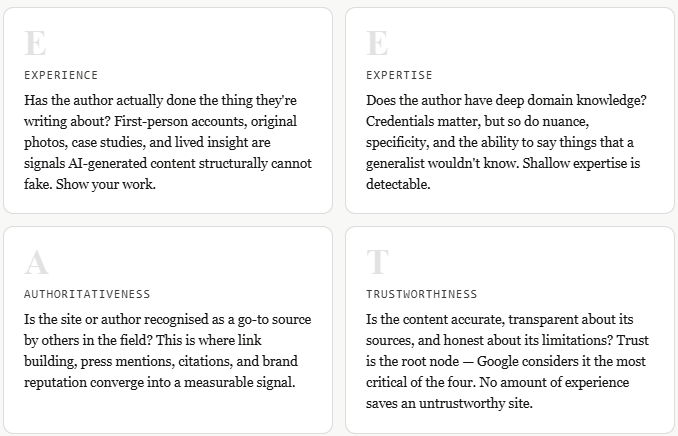
Why E-E-A-T is the bridge between classic SEO and AI search
Here’s the insight that most SEO advice misses: E-E-A-T was designed for human raters, but it maps almost perfectly onto what AI-powered search systems are trying to do. When an AI Overview surfaces a source, it’s asking the same questions: is this genuinely authoritative? Is it accurate? Does it come from someone who actually knows this domain?
The practical implication is that the highest-E-E-A-T content does double duty. It ranks organically in traditional blue-link results. It gets cited in AI Overviews. It earns the kind of links and mentions that compound authority over time. It builds a brand that survives algorithm changes because the algorithm is increasingly trying to approximate human trust — and the content already has it.
AI-generated content is table stakes now. The differentiator is content that AI cannot produce: original data, lived experience, genuine expertise, and a distinctive editorial voice.
The practical hybrid SEO checklist for 2026
If you’re building or auditing a content strategy this year, here’s what to focus on:
- Audit technical SEO as a baseline — CWVs, crawlability, structured data, schema markup for your content type
- Assign real bylines to content — named authors with bios, credentials, and verifiable expertise
- Embed original data, research, or first-person experience into every pillar piece
- Build topical authority around a defined domain — go deep, not wide
- Pursue editorial links through original research, tools, or data others want to cite
- Optimise for search intent, not just keywords — match format, depth, and angle to what searchers actually need
- Create content that AI Overviews would want to cite — factual, structured, authoritative
- Maintain consistent YMYL (your money or your life) standards on health, finance, and legal topics